

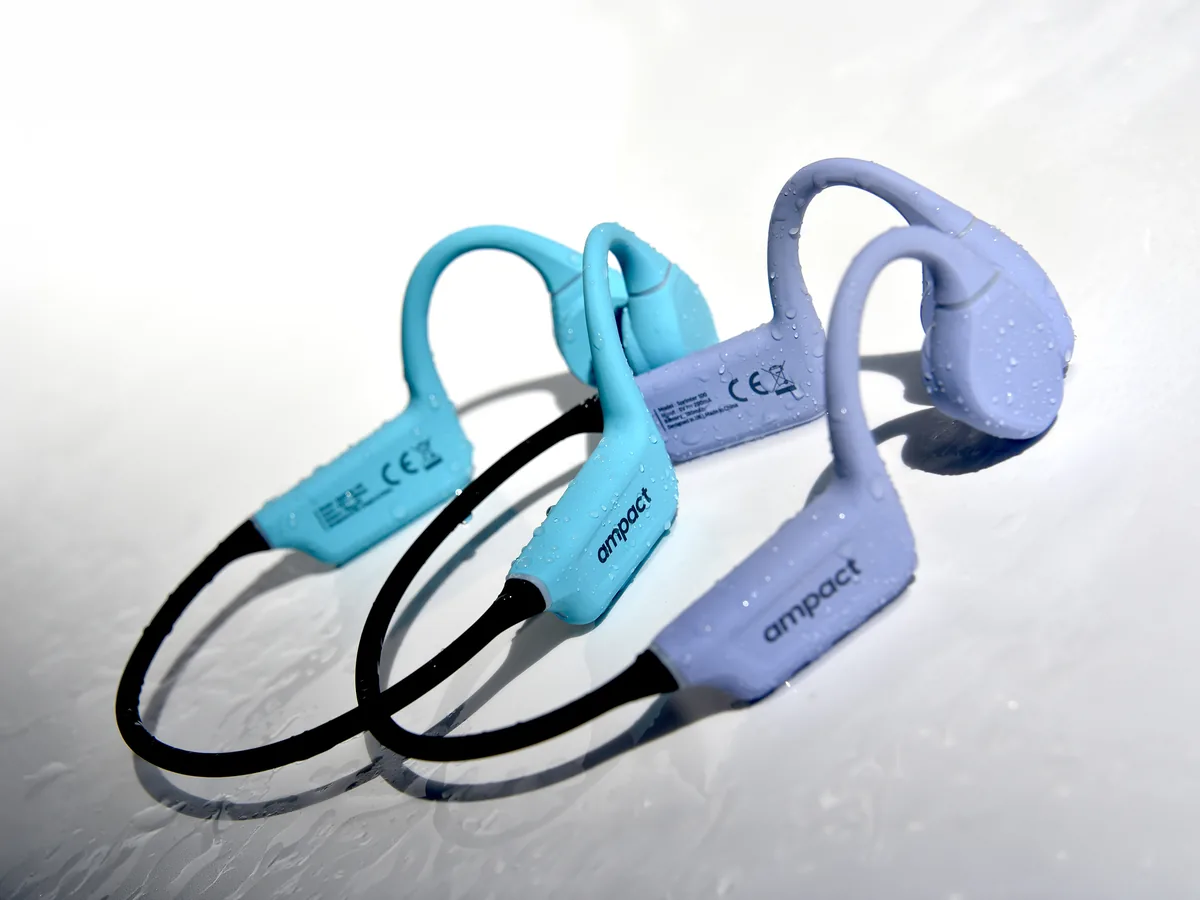

Bone conduction headphones have earned their place in sport. Open-ear awareness, no ear canal contact, freedom to move — the fundamentals are clear. But not all bone conduction headphones are created equal, and if you’re a serious athlete, the wrong choice will let you down mid-session in the water or on the trail.
Here’s what actually matters when you’re choosing bone conduction headphones for sport — from the team who built them for exactly this purpose.
COMFORT THAT LASTS HOURS, NOT MINUTES
This sounds obvious. It isn’t.
A lot of bone conduction headphones look fine in a product photo but chafe, slip, or create pressure points the moment you start moving or sweating. For sport, you need a frame that’s light enough to forget you’re wearing it and a contact material that stays comfortable through two hours of sweat without irritating your skin.
Look for silicone on any surface that touches your body. It should feel feather-light from the first minute and the last. If the spec sheet doesn’t mention the material quality, that’s your answer.
THE FIT MUST HOLD UNDER MOVEMENT
Comfort and fit are different things. Comfort is how it feels. Fit is whether it stays where it needs to be.
For running, the headphones need to stay stable through impact. For swimming, they need to hold position through backstroke flips and tumble turns — against a swim cap and goggles. For cycling, they need to sit correctly under a helmet.
The key detail most buyers overlook is transducer positioning. The transducer is the part that vibrates against your cheekbone to deliver sound. If it’s in the wrong position — even slightly — the sound quality drops significantly and you’ll find yourself fiddling with it mid-session. The best bone conduction headphones let you adjust this angle so you find the perfect position for your face shape. The Ampact Sprinter 100 includes adjustable 35° Fit-Tip arms for exactly this reason, and more — Arms out for outdoor running and cycling where full awareness matters; folded in for indoor gym sessions where you want to tune out. One headphone, two modes.

WATERPROOFING — IPX8 IS THE ONLY RATING THAT COUNTS FOR SWIMMERS
Sweat-proof is not waterproof. IPX4 and IPX5 ratings handle light splashing and perspiration. For swimmers, triathletes, open-water athletes, or anyone on serious training — that’s not enough.
IPX8 is the standard for full submersion. It means the headphones can be submerged in water to a depth of at least 1.5m for over 40min and continue functioning normally. And we test every pair to 5m. For swimming specifically, this is non-negotiable. Any bone conduction headphone without an IPX8 rating will degrade — or fail entirely eventually — in regular pool use.
The Ampact Sprinter 100 is rated IPX8. We designed it specifically for athletes who get completely wet —because we are those athletes!
MP3 MODE — ESSENTIAL FOR SWIMMERS, USEFUL FOR EVERYONE
Bluetooth doesn’t work underwater. Its radio frequency bands don’t penetrate water. This means if you want music during your swim sets — not just on the pool deck — you need a headphone with built-in MP3 storage.
The Sprinter 100 has 8GB of onboard storage and a dedicated MP3 mode. Load your playlist before you get in. Toggle between Bluetooth and MP3 with two clicks of the M button. Leave your phone in your bag.
For runners and cyclists, MP3 mode is also genuinely useful — no phone required on a long training run or remote trail ride.
CALL FUNCTIONALITY AND BLUETOOTH RELIABILITY
A dropped Bluetooth connection mid-session is more frustrating than no connection at all. Look for stable pairing, and a microphone that actually works when you need it for a call on the move.
THE SHORT VERSION: WHAT TO LOOK FOR
- Quality build with silicone, featherlight construction
- Adjustable transducer position for optimal fit and sound
- IPX8 waterproof rating — not IPX4 or IPX5
- Built-in MP3 storage for underwater use
- Stable Bluetooth and noise-reducing mic for calls
The Ampact Sprinter 100 was engineered to hit every one of these marks. We built it because we couldn’t find anything else that did.
